How to identify Sputnik 1MChZ – Authenticity Guide
The Sputnik 1MChZ stands among the most coveted timepieces in the world of Soviet watch collecting. Its enduring appeal lies not only in its rarity, but also in its powerful connection to one of the most transformative moments of the twentieth century. On 4 October 1957, the Soviet Union launched Sputnik 1, the first artificial satellite to orbit the Earth — an achievement that marked the dawn of the Space Age and fundamentally reshaped global science, technology, and geopolitics. The launch captured the imagination of millions and became a symbol of technological ambition and national pride.
Unsurprisingly, sustained collector demand has resulted in a growing presence of newly produced and counterfeit dials on the market. For those seeking an authentic example, the ability to confidently identify Sputnik 1MChZ is no longer optional—it is essential. With a structured understanding of the defining details and period-correct characteristics, identifying an original Sputnik 1MChZ becomes a disciplined and rewarding process, rather than an uncertain or intimidating endeavor.
Identify Sputnik 1MChZ – Genuine vs. Fake Dial Characteristics
To accurately identify Sputnik 1MChZ, one must begin with a careful examination of the dial, as it is the component most frequently altered, replaced, or reproduced in counterfeit and assembled examples.
Several subtle yet decisive details distinguish an authentic Sputnik 1MChZ dial from a counterfeit one, and careful observation of these elements is essential for accurate identification.
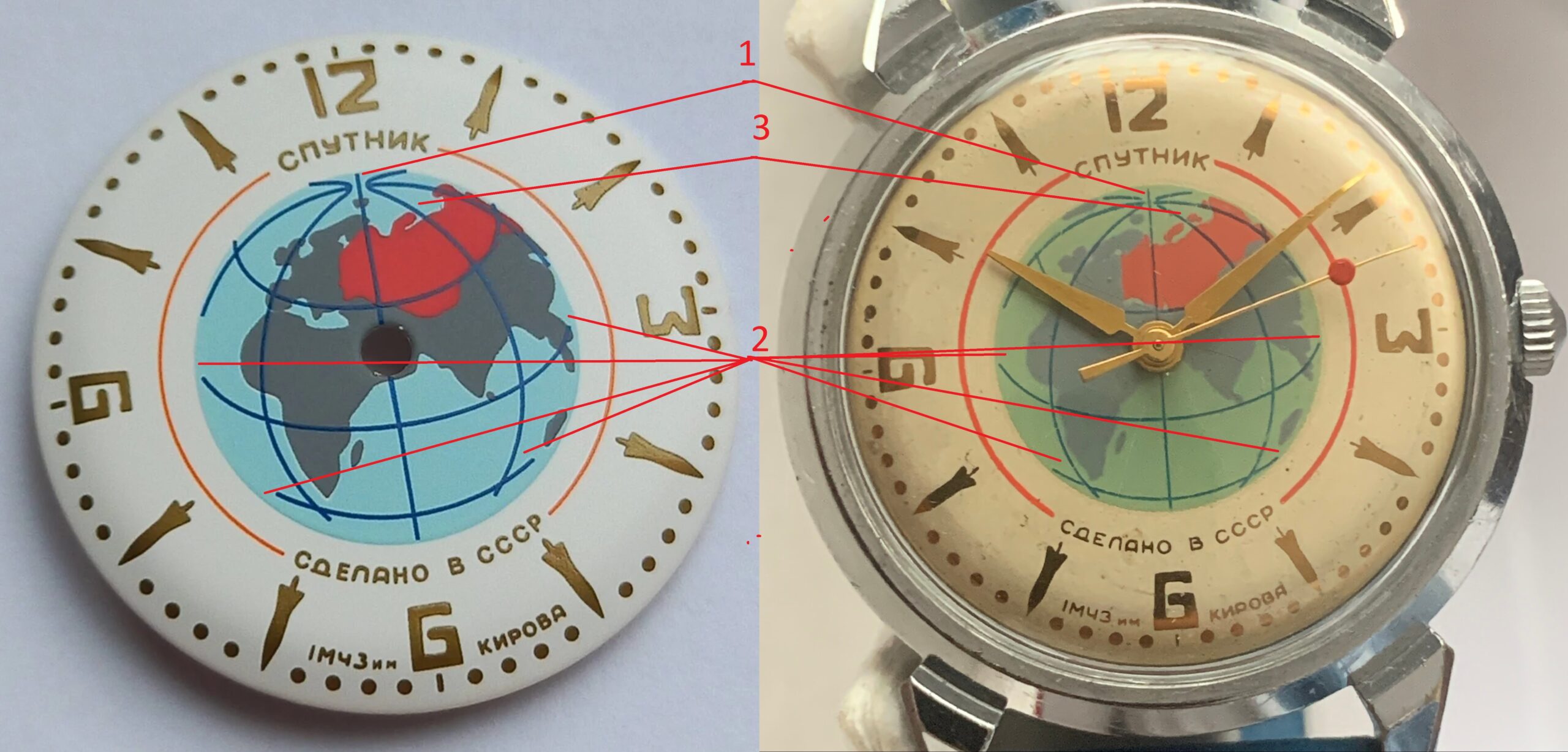
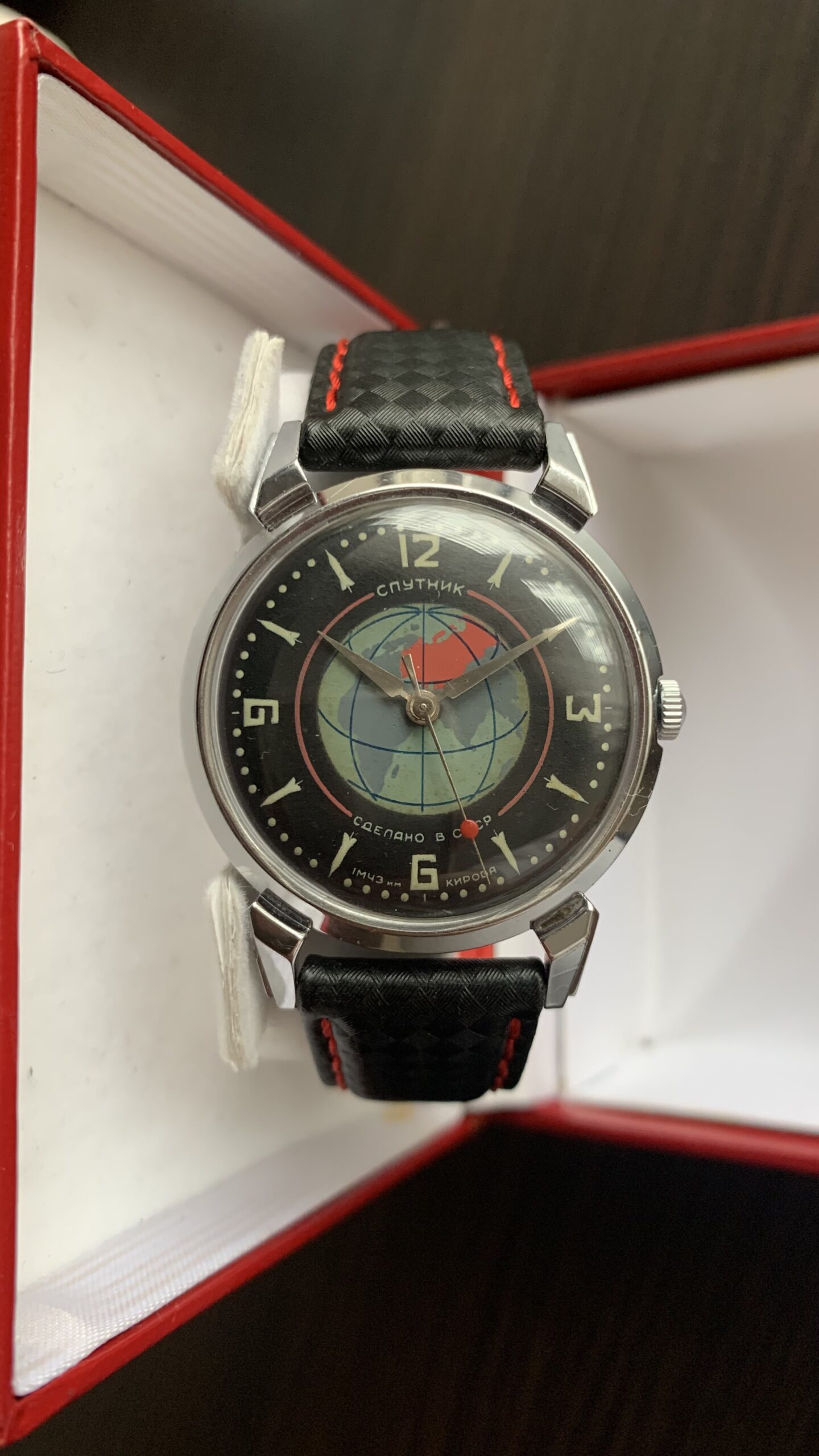
First, on a genuine dial, the meridian lines converge precisely at the North Pole, reflecting a careful and deliberate execution of the globe motif. On counterfeit dials, these meridians fail to meet at a single point, resulting in a visually inconsistent and less refined depiction.
Second, the original dial shows latitude lines (parallels) that extend fully to the edge of the globe, creating a sense of completeness and correct geographical proportion. In contrast, on fake dials these parallels stop short of the globe’s boundary, subtly but clearly breaking the intended design.
Finally, an island detail—small yet significant—is present only on the authentic dial. This feature is entirely absent on counterfeit versions, making it one of the most reliable indicators of originality for the trained eye.
Hands Matter – Identifying Original Sputnik 1MChZ Components
The seconds hand is the central and most distinctive feature of the Sputnik 1MChZ watch. Designed to embody the Sputnik satellite itself, it creates the impression of continuous orbit around the Earth as it moves across the dial. Verifying the presence of this correct hand is crucial, as its unique form was manufactured solely for the Sputnik 1MChZ and cannot be accurately replaced with a seconds hand from another Soviet watch.
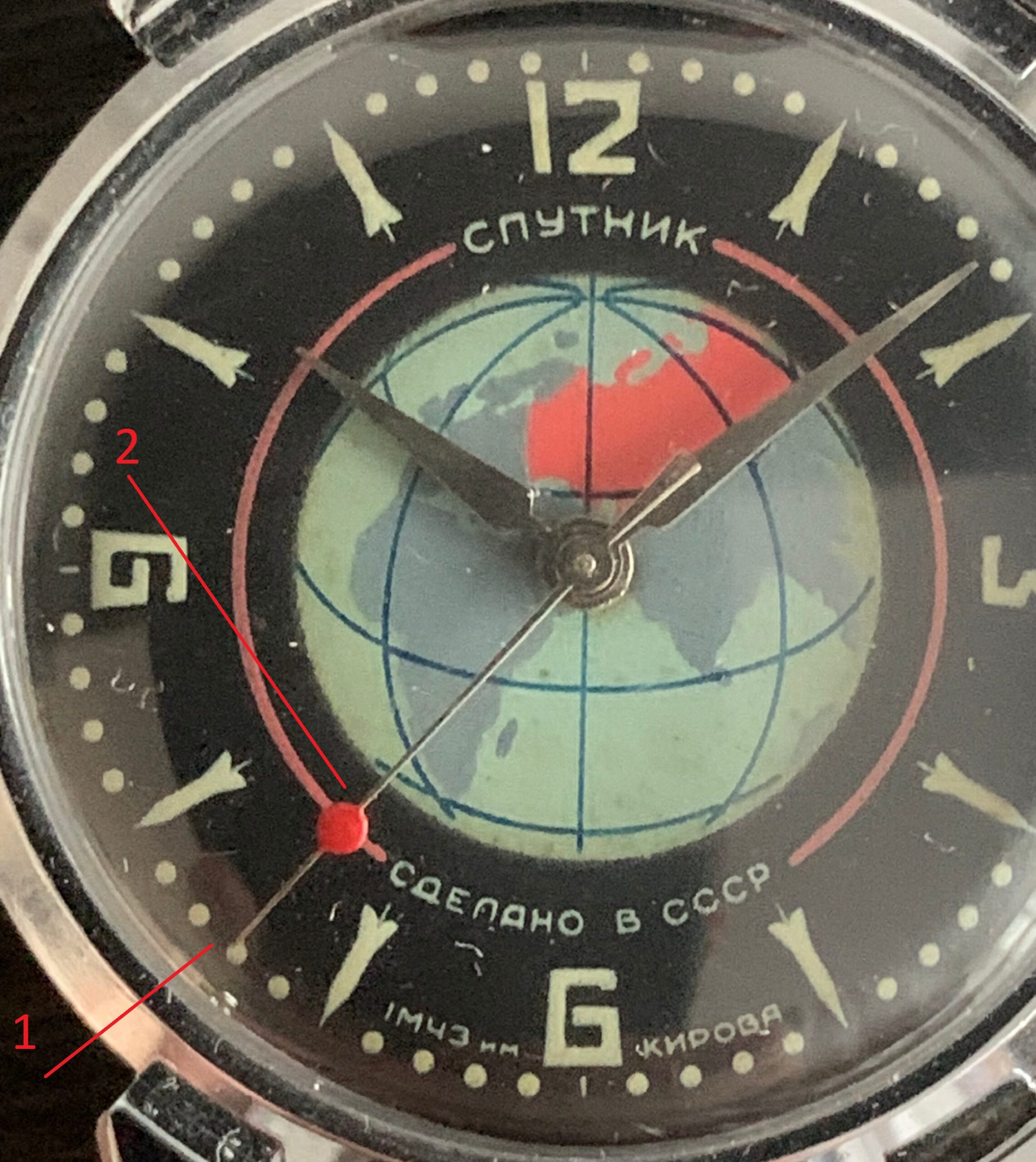
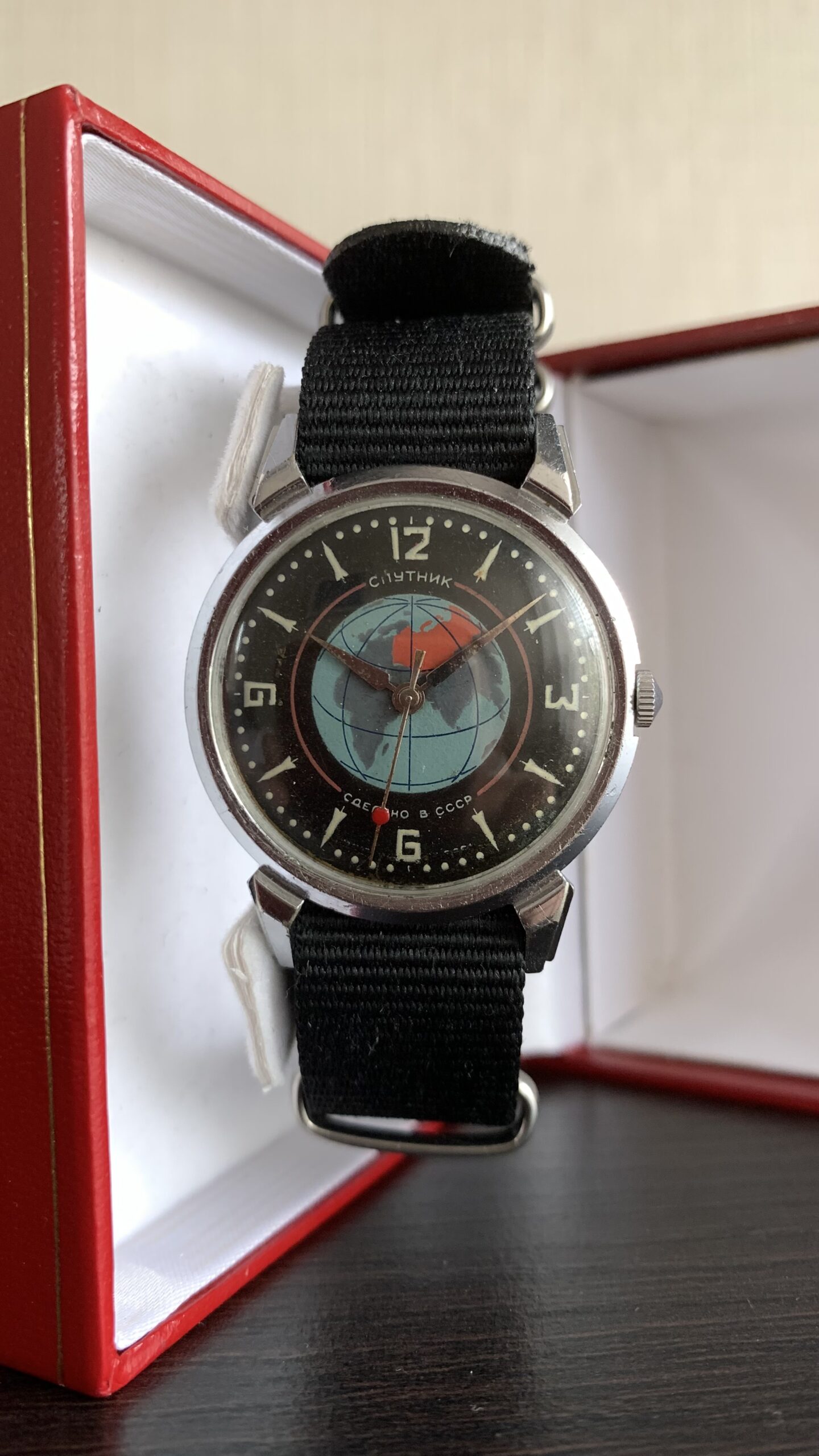
Upon examining the photographs below of Sputnik watches with white and black dials, one should note a crucial distinction: the white-dial Sputnik is fitted with gold-plated hands, whereas the black-dial variant is equipped with nickel-plated hands. This configuration represents the only historically correct and authentic pairing. Owing to their susceptibility to corrosion, the original nickel-plated hands were frequently replaced by watchmakers with gold-plated hands sourced from the more commonly available white-dial models; however, such replacements result in a so-called frankenwatch.
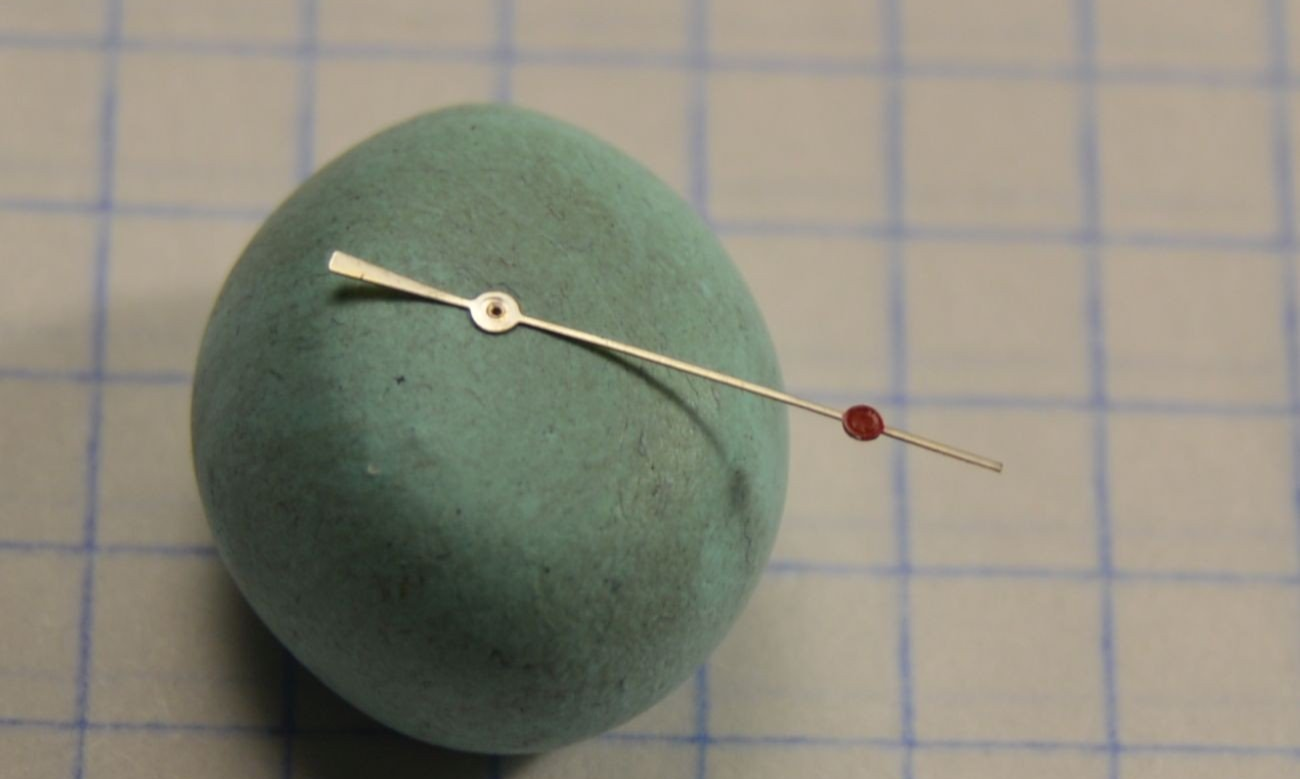
The seconds hand of the Sputnik 1MChZ closely resembles that of the standard Kirovskie Crab model, yet it is defined by one essential and unmistakable distinction: the red disc representing the Sputnik satellite. This disc is not an applied element but an integral part of the hand, manufactured from the same metal and permanently fixed in place before being finished in red paint.
An authentic seconds hand will consistently display the following characteristics:
The tip of the hand reaches precisely to the outer track of the dial, touching the small circular markers that denote the minute and second indices.
The Sputnik disc aligns exactly with the red circular line representing Earth’s orbit, maintaining perfect positional accuracy as the hand travels around the dial.
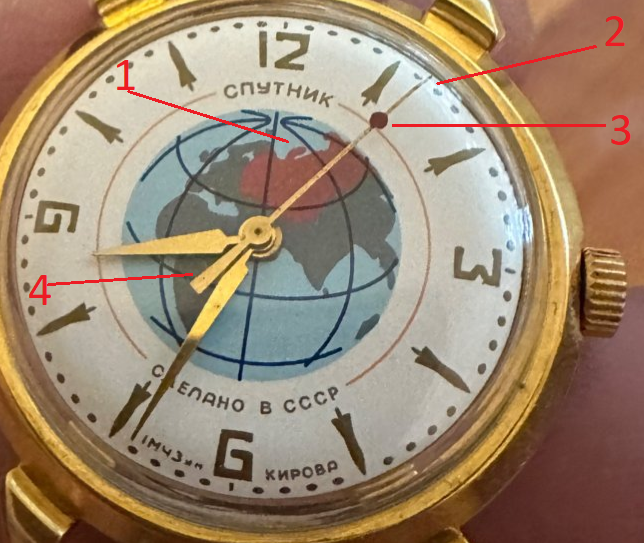
Examine the counterfeit seconds hands shown below and note that some are fitted to otherwise genuine dials. The presence of an authentic dial alone does not guarantee that a watch is entirely original, underscoring the importance of evaluating all components with equal care.
A counterfeit dial, which in itself constitutes a major red flag.
An incorrectly proportioned seconds hand that extends beyond the minute and second indices.
An undersized and misplaced Sputnik disc that fails to align with the red orbital line representing Earth’s orbit.
An oversized counterbalance, inconsistent with the proportions of an original seconds hand.
A genuine dial.
The Sputnik disc is undersized and incorrectly positioned, failing to sit above the red orbital line as it should.
The seconds hand is improperly proportioned, falling short of the minute and second indices rather than reaching them precisely.
Shown below are examples of counterfeit seconds hands presented as Sputnik 1MChZ originals. Whether these are homemade modifications or the result of small-scale industrial production remains unclear; however, their inauthenticity is readily apparent and can be identified at a glance by an experienced eye.
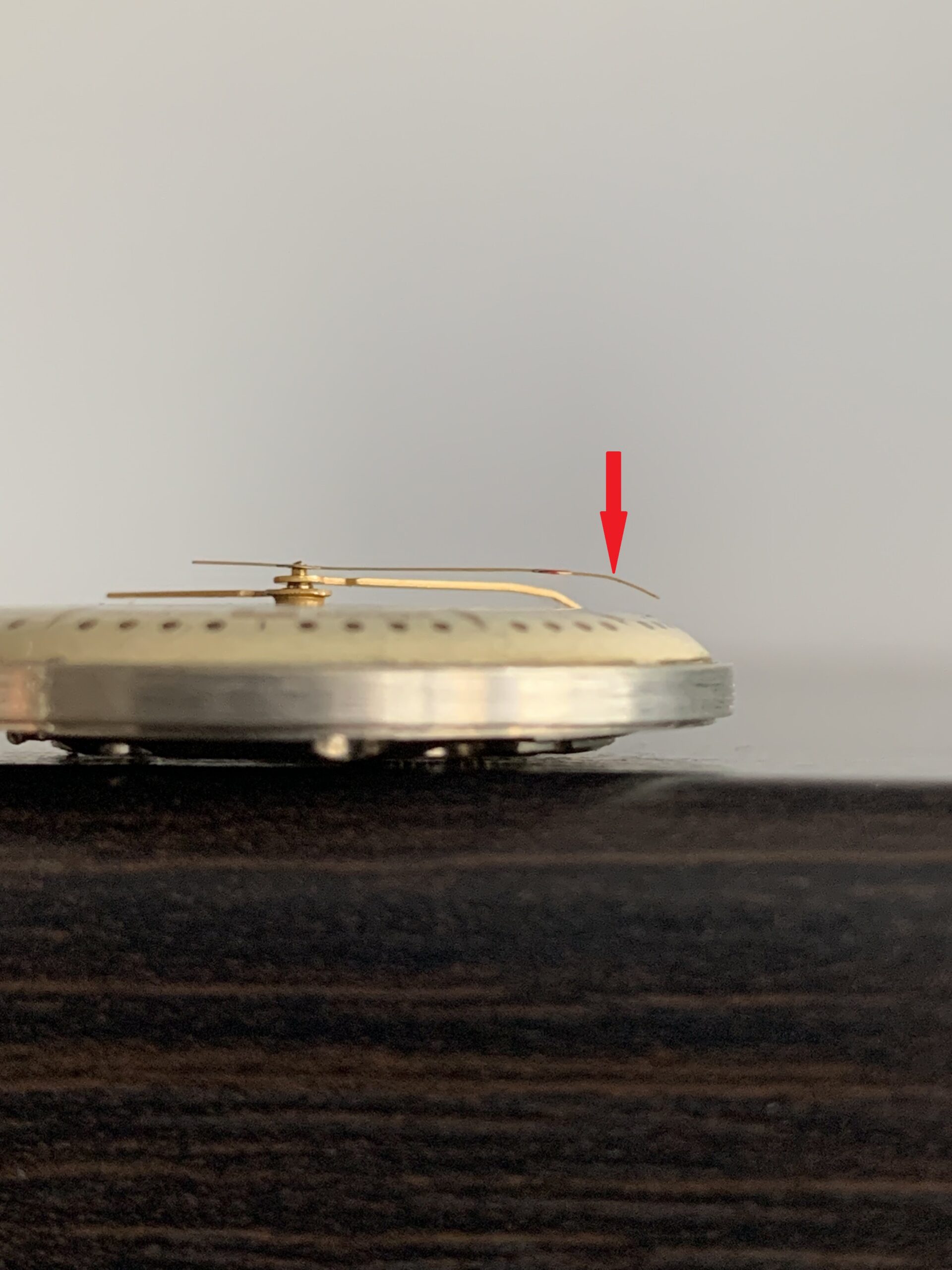
The original seconds hand is not perfectly straight; it features a subtle bend near its tip, a detail consistent with period-correct manufacturing. Additionally, when viewed from the side, the Sputnik disc remains flat, lacking any noticeable thickening. This is a crucial distinction, as counterfeit examples often display an unnaturally thick or domed disc, immediately revealing their non-genuine origin.
How to Identify Sputnik 1MChZ – Authenticity and Collectibility
The cases, crowns and movements of the Sputnik 1MChZ models are not unique and are shared with standard Kirovskie “Crab” watches. White-dial Sputniks are available in both chrome and gold-plated cases, whereas black-dial Sputniks are correctly housed exclusively in chrome cases. The movement is the widely used 16-jewel caliber 2408, a mechanism that also appears in various other Soviet watches, including both Poljot and Kirovskie models.
Sputnik 1MChZ models are among the most sought-after timepieces of the Soviet era, with counterfeit examples frequently commanding prices on par with genuine watches. Consequently, the ability to identify Sputnik 1MChZ accurately before purchase is of paramount importance. Fortunately, once the key distinguishing characteristics are understood, identifying replicas and “franken” watches becomes a relatively straightforward task. Below, we provide further examples of authentic dials to aid in your evaluation.