How to identify Sturmanskie Gagarin – Authenticity Guide
Sturmanskie Gagarin Type 1 is one of the most recognized and desired watches among Soviet watch collectors. It holds a special place in horological history. Its fame comes from its strong association with Yuri Gagarin. It is also valued because it was designed for the strict needs of military pilots and navigators.
This watch was not a regular civilian timepiece. It was purpose-built for precision. It was made for reliability. It was created to perform under pressure and in demanding flight conditions. That makes it especially attractive to collectors today.
It is widely believed that, after graduating from the Orenburg Military Pilot’s School in 1957, Yuri Gagarin was awarded his own Sturmanskie Type 1 watch. This tradition was common among elite military schools. Graduates often received high-quality equipment as a mark of achievement. Because of this historical moment, the Sturmanskie Type 1 is forever linked to the first man in space and the early era of Soviet aviation.
Movement Authentication – How to Verify an Original Calibre
The 15-jewel Sturmanskie was among the first central-second movements produced by the 1st Moscow Watch Factory, developed as an evolution of the Pobeda K–26 movement. Many fakes use a standard K-26 Pobeda movement, but the complete guide below will help you identify Sturmanskie Gagarin.
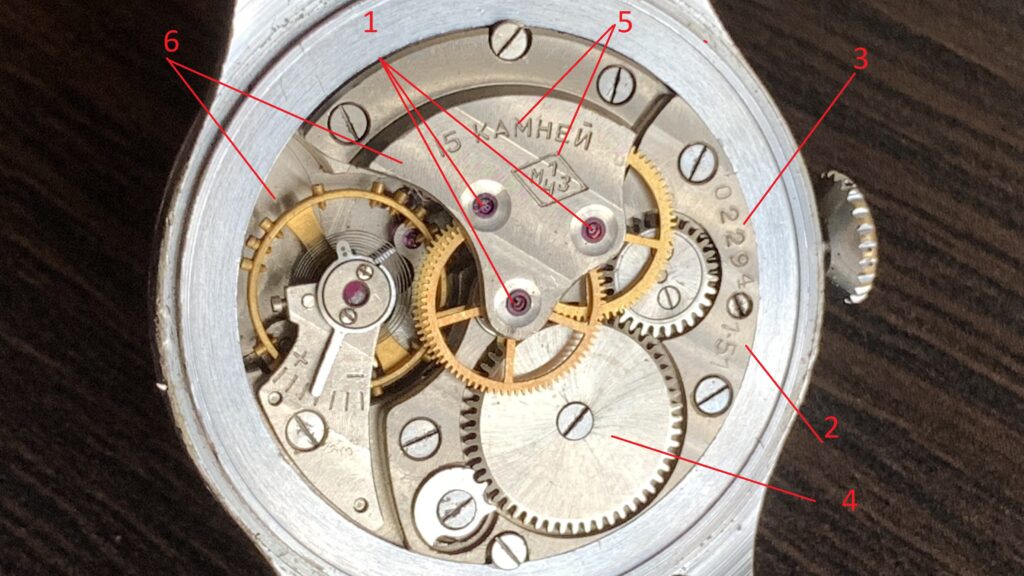
1. Jewel Setting of the Gear Train
Unlike the 15-jewel Pobeda, the jewel arrangement in this movement is different. The jewels sit in recessed openings on the top plate. These recesses are necessary to accommodate the hack-second mechanism, which requires additional space and causes the top plate to lift slightly.
2. Date Code
The calibre includes a date code consisting of one digit for the quarter and two digits for the year. Since this watch was produced between 1949 and 1954, the code should range from 1-49 to 4-53.
3. Serial Number
The serial number is a five-digit figure. In most watches on the market you will see a six-digit number which gives away that movement is from regular Pobeda.
4. Spring Ratchet Wheel
Ratchet wheel should not have any text or symbols. It features a polished finish with a shallow “S”-shaped pattern.
5. 1st Moscow Watch Factory Diamond Logo and 15 Jewels
The calibre bears the 1st Moscow Watch Factory diamond logo and the inscription “15 Jewels.”
6. Polished Moscow (Geneva) Stripes
The movement is finely finished with polished stripes, similar to the 15-jewel Pobeda models. However, in the Sturmanskie, the base plate is also polished, which can be seen beneath the balance wheel. There is no shock protection, and the balance cock is polished beneath the adjustment lever.
Identify Sturmanskie Gagarin by Assessing the Authenticity of its Dial, Crown, and Case Back
To identify Sturmanskie Gagarin, one must carefully examine its key external features, which reveal its authenticity and provenance.

7. Crown
Sturmanskie Gagarin Type 1 features a distinctive pillow-shaped crown, reminiscent of the military Pobeda models.
8. Second Hand
The seconds hand is red, terminating in a characteristic “clover-leaf” shape.
9. Hour and Minute Hands
Both hands are luminous, with the frames elegantly finished in blue.
10. Dial Markings
The dial carries no reference to “Made in the USSR” near the 6 o’clock position.
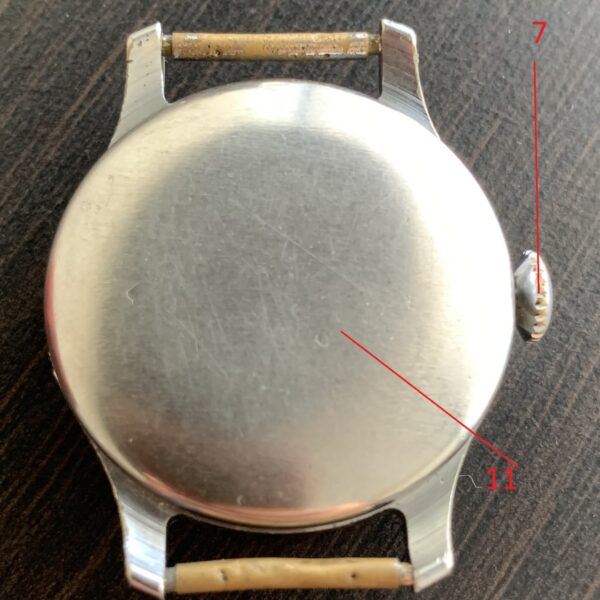
11. Case back
The case back is of the snap-on variety. On Soviet-era models, it bears no issue numbers or additional markings.
Illustrative Instances of Common Counterfeits
Start with the dial. If it looks too pristine or the expected luminescent indices and hands are absent, treat it as a red flag and approach with caution. It is highly probable that the timepiece before you is, at best, a ‘Frankenwatch,’ or, in the worst case, an outright counterfeit. Examine the following examples carefully.
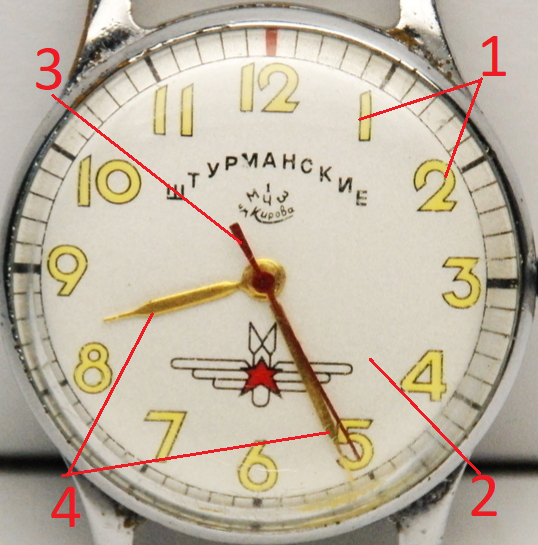
Upon close examination, it is evident that this watch exhibits multiple inconsistencies:
Absence of luminescent material on the indices.
Dial in an unusually pristine condition — retaining a snow-white appearance after more than seven decades is highly improbable.
Incorrect seconds hand — it lacks the characteristic leaf shape.
Overall, the hands are entirely inconsistent with the model’s original specifications.
In Sturmanskie gagarin Type 1, the movement is of paramount importance; therefore, even if the dial, hands, and crown appear to be genuine, it is essential to verify that the calibre is appropriate. I have encountered numerous examples of visually convincing watches fitted with movements taken from standard Pobeda models.
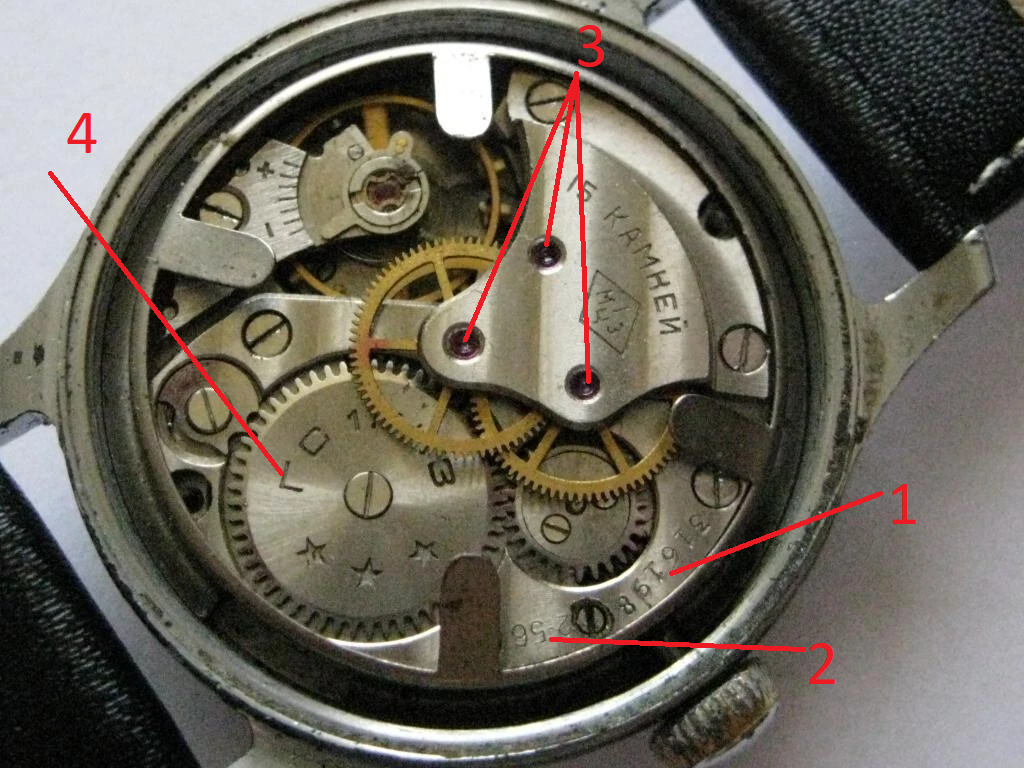
This movement is superficially similar; however, it is a standard Pobeda calibre rather than the correct Sturmanskie variant. Several discrepancies are immediately apparent:
The serial number is excessively long and should consist of only five digits.
The production date is incorrect — Gagarin-era Sturmanskie models were manufactured only up to Q4 1953.
The jewels should be set deeper in their countersinks.
The ratchet wheel should be plain, without any engraved text or symbols.
Final Thoughts and Best Practices to Identify Sturmanskie Gagarin
It may initially appear challenging to identify Sturmanskie Gagarin; however, by following this complete guide, your chances of success increase significantly. It is important to remember that if any aspect of a watch appears questionable, it is far wiser to wait for a specimen that meets all the critical criteria than to risk purchasing a so-called “frankenwatch” or counterfeit. When uncertainty arises, consulting more experienced collectors is always advisable. An excellent platform for this is the Watchuseek forum, as well as the original post there that inspired the creation of this article.